Monday, September 18, 2017
Tuesday, September 12, 2017
Monday, September 11, 2017
Thursday, September 7, 2017
Voter fraud does not exist?
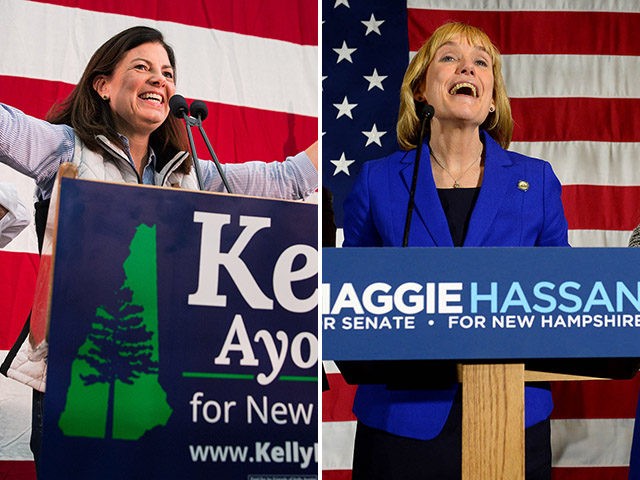
Exclusive – Kobach: It Appears That Out-of-State Voters Changed the Outcome of the New Hampshire U.S. Senate Race

Kayana Szymczak, Darren McCollester/Getty Images
For years, the mainstream media has ignored the problem of voter fraud and belittled those of us who are trying to do something about it. And when secretaries of state like me identify cases of fraud, we are told that the number of incidents of voter fraud is too insignificant to matter.
Now, however, facts have come to light that indicate that a pivotal, close election was likely changed through voter fraud on November 8, 2016: New Hampshire’s U.S. Senate Seat, and perhaps also New Hampshire’s four electoral college votes in the presidential election.
New Hampshire is one of fifteen states that allow same-day voter registration. The benefit of same-day registration is that it allows a person who has procrastinated or has forgotten to register to nonetheless cast a ballot on election day. The downside of same-day registration is that it does not allow the state time to assess the eligibility of the voter. A volunteer poll worker simply accepts a modicum of identification and takes the voter at his word that he’s a U.S. citizen resident of the state who is eligible to vote.
New Hampshire is also a battleground state. Unlike neighboring Massachusetts and Vermont, which reliably vote for the Democrat in presidential elections, New Hampshire can swing either way. It has long been reported, anecdotally, that out-of-staters take advantage of New Hampshire’s same-day registration and head to the Granite State to cast fraudulent votes.
Now there’s proof.
According to statistics released by the Speaker of the New Hampshire House of Representatives, on the date of the general election in November 2016, there were 6,540 same-day registrants who registered to vote in New Hampshire using an out-of-statedriver’s license to prove their identity. In and of itself, that doesn’t prove that any fraud occurred – theoretically, each of those individuals could have been someone who recently moved to the State and had not yet had time to get a New Hampshire driver’s license. According to New Hampshire law, a new resident has 60 days to obtain a New Hampshire driver’s license.
So if those 6,540 voters were bona fide New Hampshire residents, they would get their driver’s license no later than January 7, 2017. However, the numbers tell a very different story. It turns out that, as of August 30, 2017 – nearly ten months after the election – only 1,014 of the 6,540 same-day registrants who registered with an out-of-state license had obtained a New Hampshire driver’s license. The other 5,526 individuals never obtained a New Hampshire driver’s license. And, of those 5,526, only 213 registered a vehicle in New Hampshire.
So 5,313 of those voters neither obtained a New Hampshire driver’s license nor registered a vehicle in New Hampshire. They have not followed the legal requirements for residents regarding driver’s licenses, and it appears that they are not actually residing in New Hampshire. It seems that they never were bona fide residents of the State.
5,513 is a big number – more than enough to swing two very important elections. The closest major election was the contest between incumbent Republican U.S. Senator Kelly Ayotte and challenger Maggie Hassan (D). Hassan won the election by a razor-thin marginof 1,017 votes. Those 5,313 fraudulent votes were more than enough to swing the election. If 59.2 percent or more of them went for Hassan, then the election was stolen through voter fraud. That’s likely, since the surrounding states are Democrat strongholds.
It’s also possible that New Hampshire’s four electoral college votes were swung to Hillary Clinton through illegal voting by nonresidents. Clinton won New Hampshire by only 2,732 votes. If 74.8 percent of the 5,513 fraudulent votes were cast for Clinton, then the presidential election in New Hampshire was tipped as well.
If the presidential contest had been closer and had come down to a margin of three or four electoral college votes, then this voter fraud might have had extraordinary consequences. Regardless, in the Senate contest, it is highly likely that voting by nonresidents changed the result.
And that is already having consequences for the nation. If the 52-48 Republican-Democrat balance in the Senate were 53-47, it could change the balance in any number of votes – not the least of which would be the effort to repeal Obamacare.
But the mainstream media will tell us, “Move along, there’s nothing to see here.” Voter fraud virtually never occurs.
Kris W. Kobach is the elected Secretary of State of Kansas. An expert in immigration law and policy, he coauthored the Arizona SB-1070 immigration law and represented in federal court the 10 ICE agents who sued to stop Obama’s 2012 executive amnesty. In 2017 President Trump named him Vice Chairman of the Presidential Commission on Election Integrity. He is currently a candidate for governor of Kansas. His website is kriskobach.com.
From American Spectator. BHO forced sale of Chrysler to Fiat
China picks up where we left off — years ago.
GM’s Buick division is doing extremely well… in China. The Chinese own Volvo. And may soon own Jeep — one of the few still-viable pieces of what used to be Chrysler.
For now, it’s FiatChrysler.
Emphasis on for now.
Fiat invested in what was just Chrysler, hoping to use the once-Big Three company as a kind of Mulberry Harbor — the floating piers used by the Allies during the Normandy invasion toward the end of WW II to establish a beachhead in Europe — only this time in America and cars rather than troops. But unlike the Normandy invasion, the Fiat invasion has been a flop so far.
Sales of the company’s signature car — the 500 mini-car — are down almost 50 percent to just over 1,000 cars a month from a high of about 2,500 cars a month back in 2014, two years after Fiat’s return to America.
And that’s the high water mark.
Other Fiat models aren’t doing nearly as well.
Sales of the 500L — an upsized version of the 500 — are as lifeless as Dracula’s corpse, with the difference that Dracula rises at night. Fiat hasn’t sold more than 184 in a month so far this year. And that was a good month for the 500. A badmonth was February; 72 cars got bought and that’s it.
The only thing that seems to help boost Fiat’s stock is the rumor about Jeep. The Chinese are very interested in buying the one un-cankered portion of the FiatChrysler conglomerate — chiefly because China is a kind of Asian revivication of 1950s America and its middle class desires large, powerful vehicles — like the SUVs Jeep specializes in and because it has a rising middle class that’s able to afford them.
America’s middle class, meanwhile, continues to wane like Hugh Hefner’s bedroom prowess.
It’s not that Americans have changed their minds and no longer want large, powerful cars. The problem is their buying power has been gimped. Their incomes are lower, the cumulative bite of taxes higher and things like health care now cost the average person probably three times what they did back in 1970, leaving not much in the way of disposable income for things like cars.
And while small cars with small engines are not unreasonably priced (on an inflation-adjusted basis) big cars with big engines have grown exorbitantly expensive and thus, beyond their means.
Consider, for instance, the flat-lined Dodge/Chrysler portfolio, starting with the Dodge Charger sedan.
This car is, in terms of its general layout — rear-drive, heavy steel frame, V8 engine — very similar to the cars middle class and even working class Americans routinely drove during the heyday of America’s working and middle class, from (roughly) the mid-late 1950s through the mid-late 1970s.
What’s not similar — and accounts for the sales plummet — is the price.
The V8 Charger stickers for $34,995 — equivalent to the buying power of $5,600 back in 1970. And back in 1970, you didn’t need $5,600 to buy a large, rear-wheel-drive sedan with a V8 engine. You could, as a for instance, have bought an Oldsmobile Delta 88 for about $3,800.
And the Olds was a near-Cadillac.
$5,600 — back in 1970 — could also have bought you a V8 Corvette, Chevy’s most expensive model — and left you a few hundred bucks for gas and tires.
In between then and now, the price of cars got higher but the means available to middle-class Americans did not rise to keep up.
Fast forward to now and cars like the ones Dodge (and Chrysler) sell are not selling — except to the government (which has unlimited funds) which buys up fleets of Chargers for use as cop cars. But otherwise, forget it.
Meanwhile, China.
It is an unplowed field, rich and loamy. Brand-new superhighways, as opposed to our ancient and decrepit ones. A chunk of real estate roughly analogous to the continental United States but instead of a tired and worn out population hag-ridden by debt and with its back to the wall, a potential market at least three or four times as large and flush. Did you know that the Chinese car industry is the world’s largest car industry? That it produces more cars than the U.S. and European car industries combined? That it grows by double digits, annually?
There is a damned good reason why GM hasn’t killed off Buick.
The brand is an irrelevance here — because there is no longer a market here for a nicer-than-Chevy but-not-quite-a-Cadillac. The Americans who bought cars like that are either mostly dead or getting ready for death, whiling away their remaining hours watching Matlock reruns in old folks homes. The cohort immediately behind them, meanwhile, is trying to figure out how to afford the monthly payment on a Honda.
And the cohort behind them — the Millennials — have tuned off to cars generally, as a generation. They are the ride sharing generation. Because when you can’t afford to buy, you rent. Cars, to them, are a burden. And they are. Financially, at least.
The whole ride-sharing thing is premised on the realization that there’s only so much peanut butter left in the empty jar; it is a finger desperately trying to reach the last scraps sticking to the wall.
Find Out More >
But China?
It’s like a case of unopened jars of peanut butter. Cases. Stacked a mile high and as far as the eye can see. One-point-four billion Chinese, lopsided to the left of 50, in their prime car buying years and with the means to buy cars and the desire to buy them.
How do you say “Motor City” in Mandarin?
Saturday, September 2, 2017
Tax Burden Too High
Americans spent more money on taxes than they did on food and clothing last year, according to data released earlier this week.
In an assessment of “Consumer Expenditures” for 2016, the Bureau of Labor Statistics showed the average bill for federal, state and local taxes was $10,489.
By comparison, Americans spent $9,006 on food and clothes, with most of that going toward food.
CNSNews.com first pointed out the findings. While it may not come as a surprise that American households are shelling out to Uncle Sam, the data showed that bill has risen sharply in recent years — the average tax bill rose 41 percent overall since 2013.
According to the BLS, federal income taxes rose from $5,743 to $8,367 in that period. State and local income taxes rose from $1,629 to $2,046.
The stats come as President Trump prepares to pressure Congress to pass tax reform. In a Missouri speech on Wednesday, he called for simplifying the system and lowering rates.
“This enormous complexity is very unfair,” the president said. “It disadvantages ordinary Americans who don’t have an army of accountants while benefiting deep-pocketed special interests.”
According to BLS, the largest expense for Americans in 2016 was on “housing,” costing an average consumer unit $18,886 during the year.
Subscribe to:
Posts (Atom)